
Blog / Strength
Lifting weights and your brain in your 40s and 50s
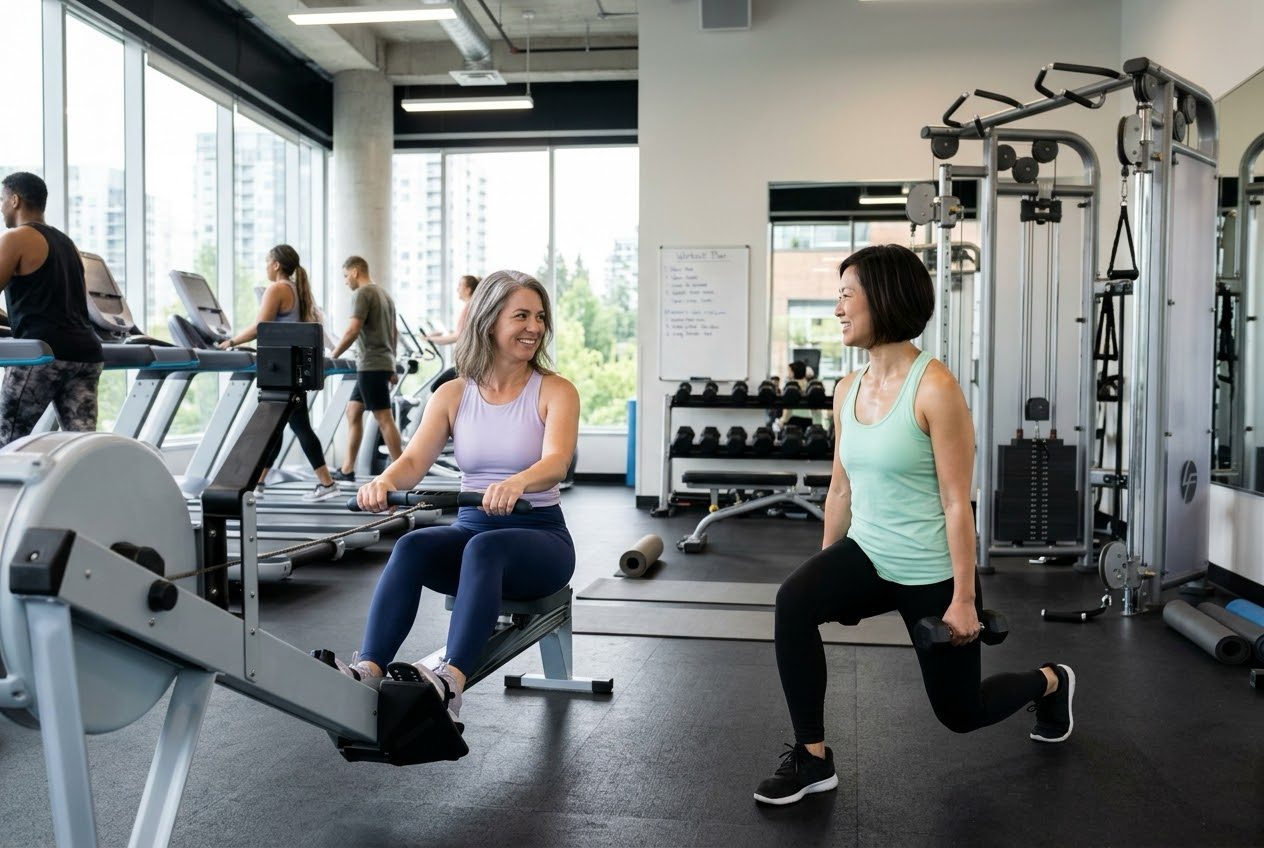
Can lifting weights help your brain as you get older? A new study of women in midlife looked at exactly that. Here's what it found, and what it doesn't prove.
What the study did
In October 2026, a team of researchers published a study in Medicine & Science in Sports & Exercise, one of the leading sports science journals. They tested 93 women aged 35 to 63 on three things:
- Reaction time: how fast you respond to something you see.
- Working memory: holding and using information in your head, like remembering a phone number while you dial it.
- Planning: thinking several steps ahead to solve a puzzle.
They also asked how often the women exercised, and what kind of exercise they did: strength training, cardio, or something else.
What they found
- Women who lifted weights had the fastest reactions. They were quicker than women who didn't exercise, and also quicker than women who did cardio or other exercise.
- Any regular exercise helped working memory, and the women further into midlife seemed to gain the most from it.
- Planning didn't change with exercise. It followed age only, whatever kind of exercise the women did.
An earlier study by the same team, with female office workers, pointed the same way: women who exercised regularly kept their test scores steady across ages, while inactive women scored lower the older they were.
What it does and doesn't mean
This kind of study takes one snapshot of a group of women. It shows that regular exercise and a sharper brain go together, but it can't prove that one causes the other. Maybe women with sharper minds also find it easier to keep exercising.
Other research isn't all positive either. A large US study followed about 1,700 women from their mid-40s for many years and found that their usual, self-chosen exercise did not slow down their brain's aging. So exercise is not a guaranteed shield.
What we can say: lifting weights is linked with a quicker brain in midlife women, and it supports your strength, bones and daily life. That's a good reason to keep a barbell or a pair of dumbbells in your week.
How to start, or keep going
- Lift two or three times a week. Whole-body sessions are perfect.
- Keep it regular. In the study, "regular" was what counted. A steady habit beats a burst of enthusiasm.
- Make the sets challenging, with one to three reps left in the tank.
- Add cardio you enjoy on other days. Walking counts.
- Learn new moves now and then. Learning keeps your brain busy too.
If you have a health condition or haven't exercised in a long time, check with your doctor before you start.
Where GymGirl fits in
Plans to try: Strong for Life Start (2 or 3 days) if you're new to lifting. Already lifting? Strong for Life builds strength, muscle and balance, and Strong for Life Plus adds heavier lifting and a little power work.
Sources
- Wong PL, Chen YL, Juan CH (2026). Regular exercise moderates age-related cognitive differences in midlife women: domain-specific effects on processing speed and working memory. Medicine & Science in Sports & Exercise, published ahead of print 27 October 2026. DOI: 10.1249/MSS.0000000000004202.
- mindbodygreen (2026). This exercise can help you build a sharper brain in your 40s & 50s (a plain-language summary of the study above).
- Chen YL et al. (2024). Association between physical activity, body composition, and cognitive performance among female office workers. Progress in Brain Research.
- Greendale GA et al. (2021). Physical activity and cognitive performance among women at midlife. JAMA Network Open.
This article is general information, not medical advice.
Read next
 Strength
 Strength