
Blog / Strength
A full home workout with just dumbbells and bands
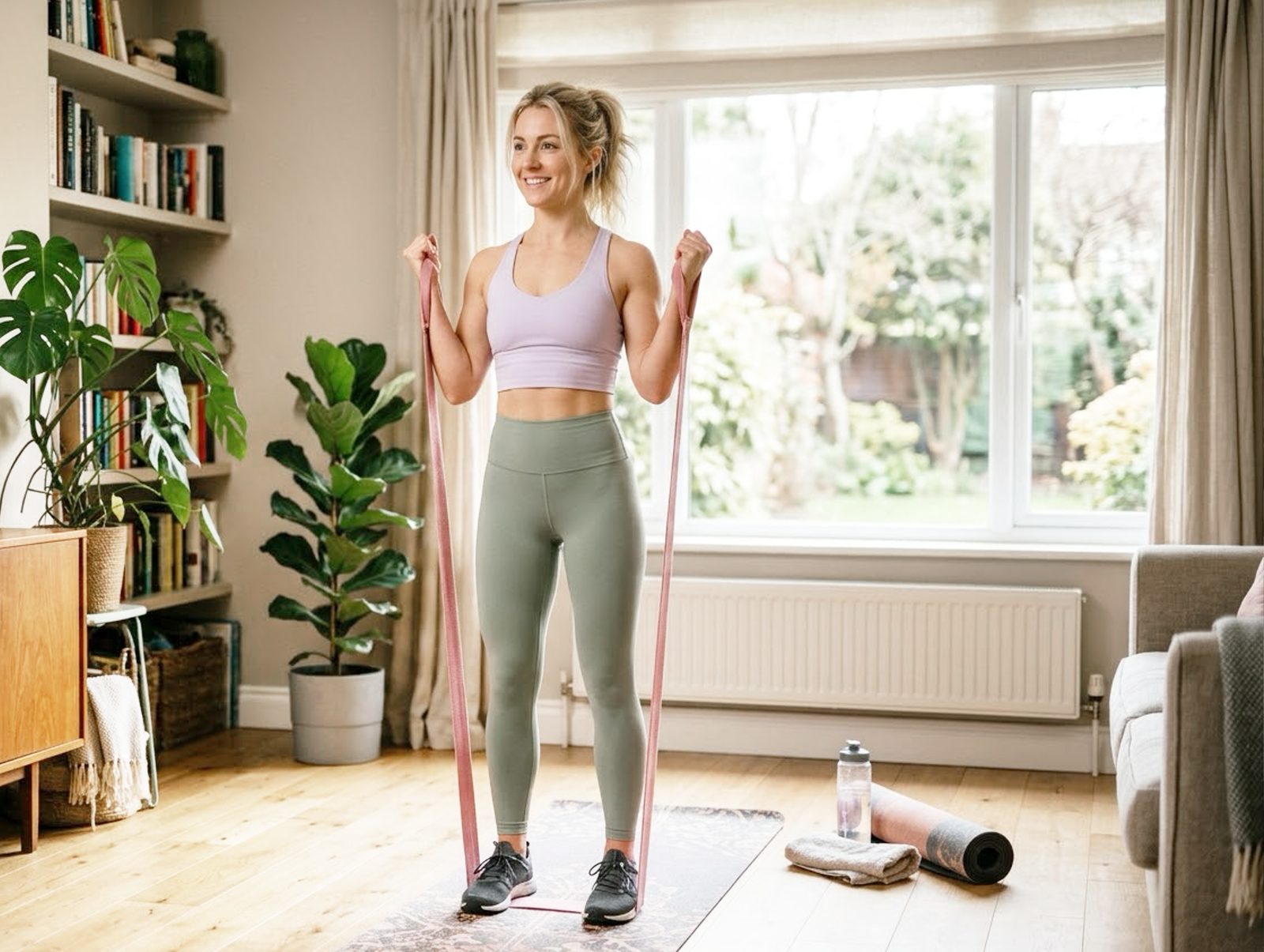
Mia has a busy job and a four-year-old. Driving to the gym, training and driving back takes almost two hours. So she bought a pair of adjustable dumbbells and a set of bands. Now the question: is that really enough to get strong?
Yes, home training works
The new 2026 guidelines from the American College of Sports Medicine, based on 137 research reviews, say it clearly: you don't need a gym. Elastic bands, bodyweight and home routines give real, measurable gains in strength, muscle size and everyday fitness.
Bands in particular get underrated. A 2019 review pooled eight studies that compared training with elastic bands or tubes against training with machines and dumbbells. Strength gains were about the same, for both the upper and the lower body.
What matters is the same at home as in the gym: train each muscle group regularly, make your sets hard enough, and ask a bit more of yourself over time.
What you need
- Dumbbells: one adjustable pair, or two or three fixed pairs (for example 4, 8 and 12 kg).
- Bands: a mini band (the small loop for around your legs) and one or two long bands with handles or loops.
- Optional: a sturdy chair or sofa for hip thrusts and split squats, and a mat.
The workout
Do this two or three times a week, with at least one rest day in between. Rest about 60 to 90 seconds between sets. Each set should end with one to three reps left in the tank.
Warm-up (5 minutes): march on the spot, 10 bodyweight squats, 10 glute bridges, arm circles.
| Exercise | Sets × reps | Works |
|---|---|---|
| Goblet squat (one dumbbell at your chest) | 3 × 8–12 | Glutes, thighs |
| Dumbbell Romanian deadlift | 3 × 8–12 | Glutes, hamstrings |
| Dumbbell hip thrust (shoulders on the sofa) | 3 × 10–15 | Glutes |
| Banded side walk (mini band above the knees) | 2 × 12–15 steps each way | Side of the glutes |
| One-arm dumbbell row | 3 × 8–12 per side | Back, arms |
| Push-up (on a bench or your knees if needed) | 3 × as many as you can with good form | Chest, arms |
| Dumbbell shoulder press | 3 × 8–12 | Shoulders |
| Band pull-apart | 2 × 15–20 | Upper back, posture |
| Dead bug | 2 × 8 per side | Core |
The whole workout takes about 40 to 45 minutes. Short on time? Do only the first five exercises.
How to keep progressing at home
At some point your heaviest dumbbells will feel light. That's a good sign, and there are many ways to keep going:
- Add reps. Go from 12 to 15, then 20 reps with the same weight.
- Slow down. Take three seconds to lower the weight. The same dumbbell suddenly feels much heavier.
- Pause. Hold for one or two seconds at the hardest point, for example at the top of a hip thrust.
- Go one leg at a time. A goblet squat becomes a split squat, a hip thrust becomes a single-leg hip thrust. That roughly doubles the load on each leg.
- Add a band. Put a band over your hips on hip thrusts, or under your feet on a shoulder press.
- Buy one heavier pair. When all of the above is easy, it's time.
Where GymGirl fits in
GymGirl is made for exactly this kind of training. Tell the app what you have at home, and your plan uses only that equipment. Travelling or back at the gym? Switch your gear in a few taps, and your plan follows. The built-in coach knows the real steps of your dumbbells, so it only suggests weights you actually own, and when you're at your heaviest, it asks for more reps instead.
Plans to try: pick a plan like Glute Starter and set your gear to what you have at home; the exercises switch to match. For no-equipment cardio days, try Home Cardio: dancing, boxing and bodyweight circuits.
Sources
- Lopes JSS et al. (2019). Effects of training with elastic resistance versus conventional resistance on muscular strength: a systematic review and meta-analysis. SAGE Open Medicine 7.
- McMaster University (2026). Consistency over perfection, new resistance-training guidelines say. About the ACSM Position Stand in Medicine & Science in Sports & Exercise.
This article is general information, not medical advice.
Read next
 Strength
 Strength