
Blog / Cardio
Smile through your hardest sets: why it can make effort feel easier
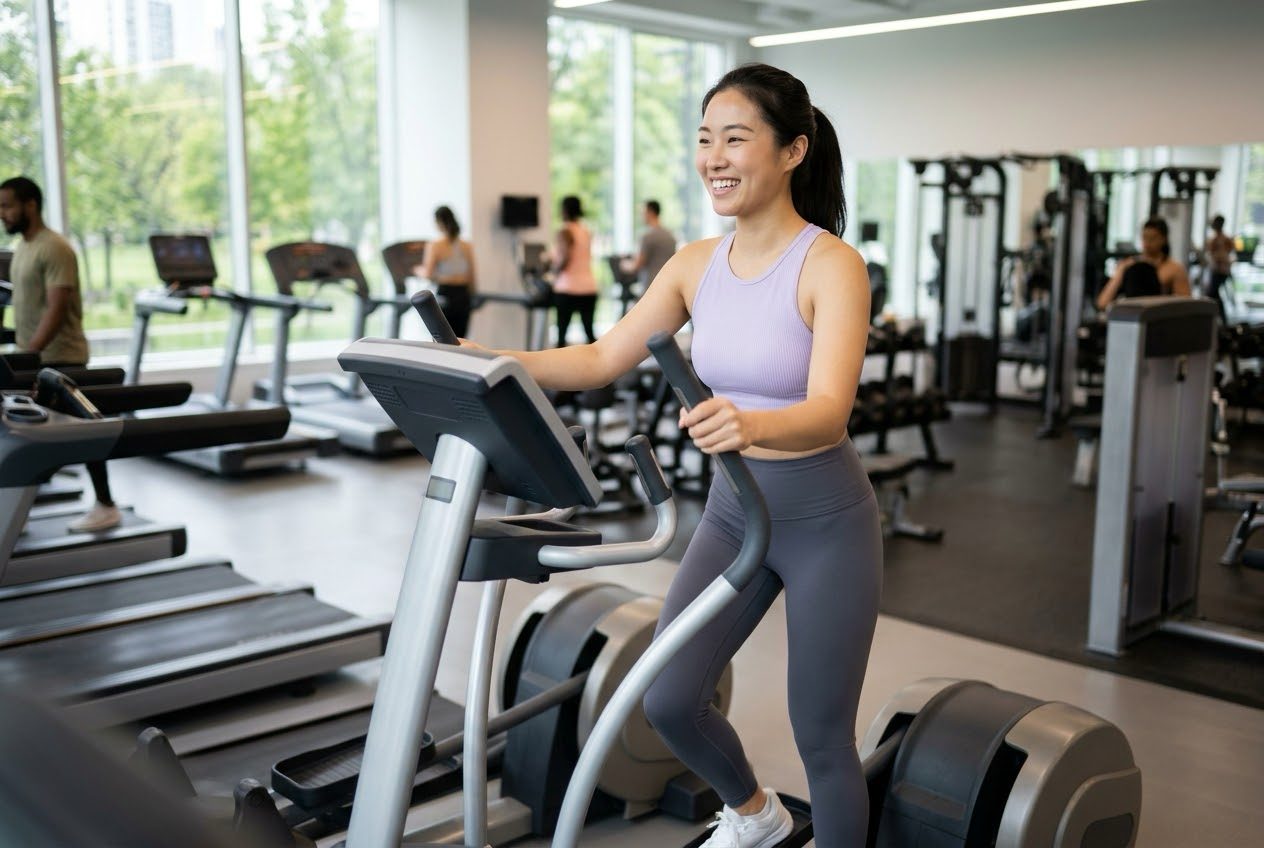
You're at the last minute of an interval, or the last reps of a hard set. Your face does what everyone's face does: it scrunches into a grimace. It feels natural. But what if that frown makes the effort feel even harder?
What the study did
In 2018, researchers at Ulster University and Swansea University in the UK asked 24 trained club runners, 13 men and 11 women, to run on a treadmill with a breathing mask. They ran four six-minute blocks at a hard pace: once smiling, once frowning, once consciously relaxing their hands and upper body, and once just running as usual.
The mask measured how much oxygen they used. That shows how much energy running costs at a given speed. Less oxygen for the same pace means you're running more efficiently.
What they found
- Smiling made running more efficient. The runners used less oxygen when they smiled, up to about 2.8% less than when they frowned.
- Frowning made it feel harder. The runners rated their effort higher when frowning than when smiling or relaxing.
- Not everyone responded the same way. Some runners were actually more efficient with a frown, so a "game face" may work for some people.
Why would a smile help? The researchers think smiling lowers tension in the body, and a relaxed body wastes less energy. Your face also sends signals to your brain: a smile is linked with feeling fine, a frown with strain.
A 2.8% difference sounds small. But the lead researcher said it could mean roughly 2% faster times, about 30 seconds on a 25-minute 5K.
What we don't know yet
This was one small study, with running only. Nobody has properly tested yet whether smiling helps with lifting weights. So treat it as a free experiment, not a magic trick.
Plans to try: Cardio & Strength (3 or 4 days) for strength first, then intervals. At home without equipment? Home Cardio: dancing, boxing and bodyweight circuits.
Sources
- Brick NE, McElhinney MJ, Metcalfe RS (2018). The effects of facial expression and relaxation cues on movement economy, physiological, and perceptual responses during running. Psychology of Sport and Exercise 34:20–28.
- Brick NE, Metcalfe RS (2018). Smiling boosts running performance. The researchers' own summary, first published by The Conversation.
This article is general information, not medical advice.
Read next
 Getting started
 Glutes