
Blog / Getting started
How heavy should you lift as a beginner?
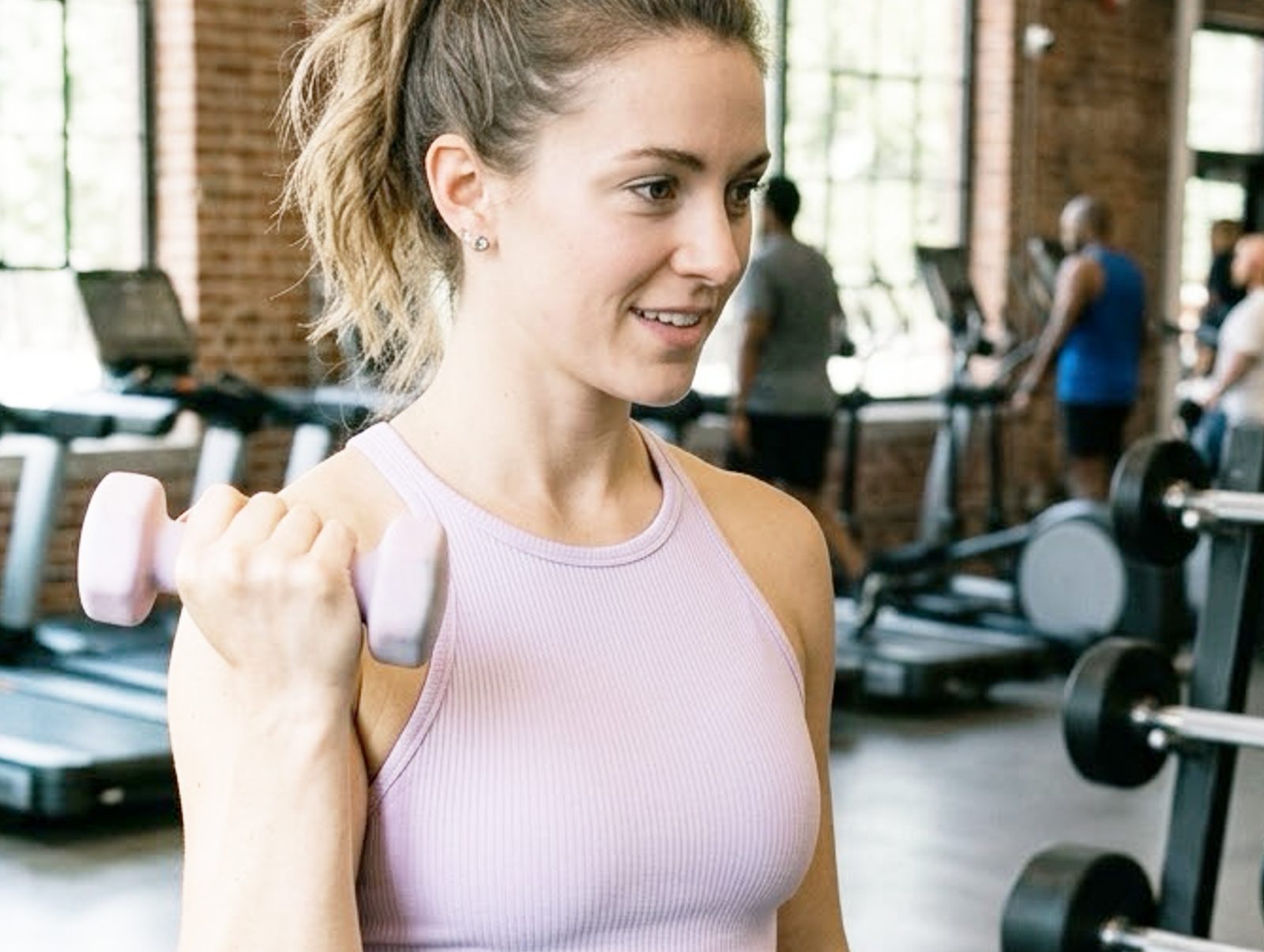
You walk into the gym, pick up a pair of dumbbells and wonder: is this too light? Too heavy? Everyone around you seems to know. Here's the good news: you don't need to know your "perfect" weight on day one. You need a simple way to find it, and then a way to keep moving it up.
Light or heavy: both build muscle
Many women think they have to lift very heavy to see results, or the opposite: that light weights are for "toning" and heavy ones make you big. Research says something simpler.
A 2017 review pulled together 21 studies that compared light weights (60% of your maximum or less, so many reps) with heavy weights (more than 60%, so fewer reps). In those studies, people pushed every set until they couldn't do another rep. Muscle growth was about the same with light and heavy weights. Heavy weights did win for maximum strength, the heaviest weight you can lift once.
So: for muscle and shape, the weight matters less than how hard the set is. For pure strength, heavier helps.
How hard should a set feel?
This is the part that matters most. A good working set ends when you have one to three reps left in the tank. You could squeeze out one or two more with good form, but it would be tough.
If you finish a set of 12 and could easily do 10 more, the weight is too light. If you can't reach 8 without your form falling apart, it's too heavy.
You don't have to go all the way until you can't move the weight. The new 2026 guidelines from the American College of Sports Medicine found that training to complete failure did not consistently make a difference for most healthy adults. Close is enough.
Find your starting weight in one workout
- Pick a rep range. For most exercises, 8 to 12 reps is a great place to start. For small moves like lateral raises, go a bit higher: 10 to 15.
- Warm up light. Do one easy set with a weight that feels like nothing.
- Go up step by step. Do a few reps with a slightly heavier weight. Still easy? Go up again.
- Stop when it gets challenging. The right weight is the one where you reach your reps with one to three left in the tank.
- Write it down. That's your starting weight. Next time, aim for one more rep.
Your first guess will often be too light. That's fine. It's much better to start light and move up fast than to start too heavy and hurt your form.
Some starting points
Every body is different, so treat these as a rough first try, not a rule:
| Exercise | First weight to try |
|---|---|
| Goblet squat | One dumbbell of 6–10 kg |
| Dumbbell Romanian deadlift | 2 × 6–10 kg |
| Hip thrust | Empty bar (often 20 kg) or a 10–16 kg dumbbell on your hips |
| Dumbbell row | 6–10 kg per hand |
| Shoulder press | 4–6 kg per hand |
| Lateral raise | 2–4 kg per hand |
How much is enough?
The 2026 guidelines give two simple targets. For strength: heavier weights, 2 to 3 sets per exercise. For muscle growth: about 10 hard sets per muscle group per week. Training each muscle group at least twice a week is a good rhythm for most people.
And the most important line in those guidelines: the best program is the one you'll actually stick with.
Where GymGirl fits in
In GymGirl, every exercise has a written guide and a body map that shows which muscles you're using. You log your first sets, and from then on the built-in coach tells you what to lift next time: more reps, a heavier step, or a lighter weight if it was too much. You start where you are, and the app helps you build from there.
Plans to try: Glute Starter (2 or 3 days) if glutes are your goal, or Strength (2 days, Level 1) for your whole body. In your 40s or beyond? Strong for Life Start is a gentle way in.
Sources
- Schoenfeld BJ, Grgic J, Ogborn D, Krieger JW (2017). Strength and hypertrophy adaptations between low- vs. high-load resistance training: a systematic review and meta-analysis. Journal of Strength and Conditioning Research 31(12):3508–3523.
- American College of Sports Medicine (2026). ACSM unveils landmark 2026 resistance training guidelines. Position Stand in Medicine & Science in Sports & Exercise.
This article is general information, not medical advice.
Read next
 Getting started
 Getting started